Electric Truck Home Charging Guide
Start with the miles you need to replace
A home charging setup should match your daily driving and the time your truck spends parked. Start with a week of typical mileage rather than the size of the battery. A large pack does not need to be refilled from empty every night. Record commuting, errands, and occasional towing separately so an unusually long trip does not dictate every equipment decision.
Estimate battery energy by multiplying daily miles by your observed kWh per mile. For an illustrative 40-mile day at 0.5 kWh per mile, that is 20 kWh delivered to the battery. At 90% charging efficiency, the wall supplies about 22.2 kWh. These are planning inputs, not measured results for any particular truck.
Understand the equipment bottleneck
The wall unit is usually electric vehicle supply equipment (EVSE); the vehicle contains the AC charger. The circuit, EVSE setting, cable, connector, and vehicle each impose limits. Buying a higher-power wall unit will not make a vehicle accept more AC power than its onboard charger supports.
A household outlet may replace only a modest amount of energy overnight. A dedicated higher-voltage circuit can be more convenient for regular truck use, but the correct installation depends on your property and driving. Use the charging time calculator to compare scenarios before requesting quotes.
Ask for an electrical assessment
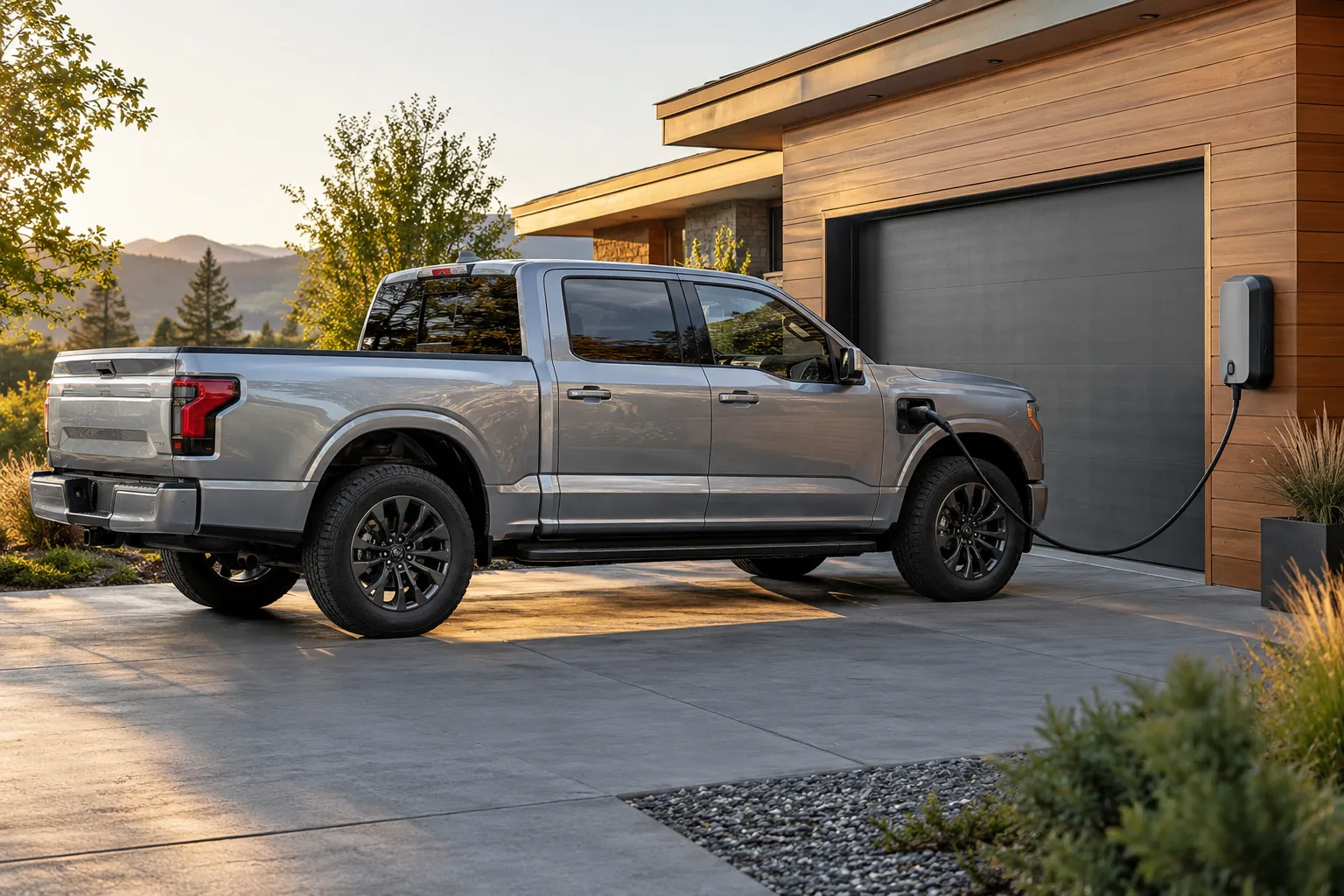
Have a qualified electrician evaluate service capacity, panel space, cable routing, permitting, and the chosen location. Ask whether load management is suitable before assuming a service upgrade is necessary. An outdoor installation also needs equipment rated for the environment and a practical cable path.
Request an itemized quote that identifies equipment, labor, permits, any utility coordination, and commissioning. Do not treat a spare breaker position as evidence that adequate electrical capacity exists. This guide is a planning checklist, not wiring instructions.
Choose for daily usability
Check the actual connector fitted to your truck and the adapters the manufacturer approves for the specific charging mode. AC and DC adapters are different. A physically fitting connector alone does not establish electrical or software compatibility.
Measure the cable path with the truck parked normally. Consider reversing into the driveway, snow clearance, door openings, lighting, and a cable holster that keeps the lead off walking routes. Decide whether scheduling must work without an internet connection and whether more than one vehicle may need charging.
Read the utility tariff
Your electricity bill may include time-of-use periods, fixed fees, taxes, or demand charges. Use the marginal rate that applies when charging rather than dividing the whole bill by total household use without checking its structure. Public charging can have different billing units and idle fees.
Set a schedule only after checking that it still provides enough energy before departure. Compare a few realistic charging windows in the cost calculator. The lowest overnight rate is useful only if the truck is ready for its next journey.
Commission, record, and revisit
After installation, ask the installer to demonstrate operation and explain any load-management behavior. Save the model number, receipt, permit information, and warranty documentation. Follow the vehicle manual for charge limits and routine charging recommendations.
Review actual energy use after several weeks. Include winter and towing days before concluding that the installation is too small. A reliable, convenient setup is more valuable than unused peak charging power.
How long does an electric truck take to charge?
First calculate the battery energy required: usable capacity multiplied by the change in charge percentage. In a hypothetical 120 kWh truck, charging from 20% to 80% adds 72 kWh. With a constant 11 kW input and 90% efficiency, the charging-time calculator gives about 7.3 hours. These are illustrative assumptions, not specifications or a guaranteed overnight result.
Divide the required battery energy by input power multiplied by efficiency. Use the lowest applicable vehicle, EVSE and circuit limit for an AC scenario. A larger charger label cannot remove the truck’s onboard limit. Replace the example with the actual usable capacity and permitted equipment for your vehicle.
For a road-trip DC stop, look for a documented charging curve or a time tied to a specific charge window. Ford’s 2025 sheet lists about 38 minutes from 15% to 80% for its 123 kWh example using a 150 kW-or-higher station. That is a manufacturer scenario, not a verified vehicle peak. Entering peak kW as constant power can underestimate the stop because charging tapers.